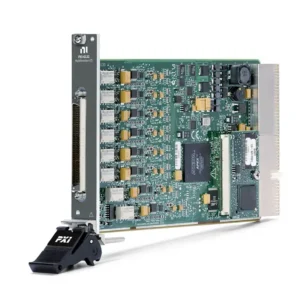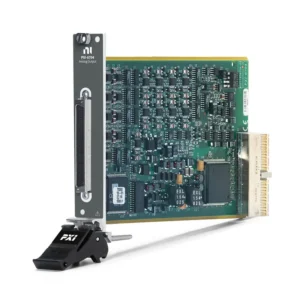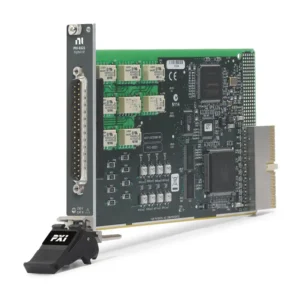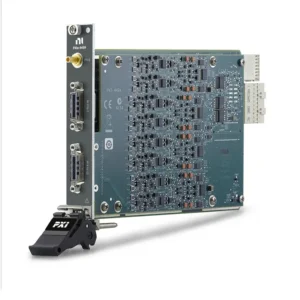


NI-9230 3-Channel Sound and Vibration Input Module
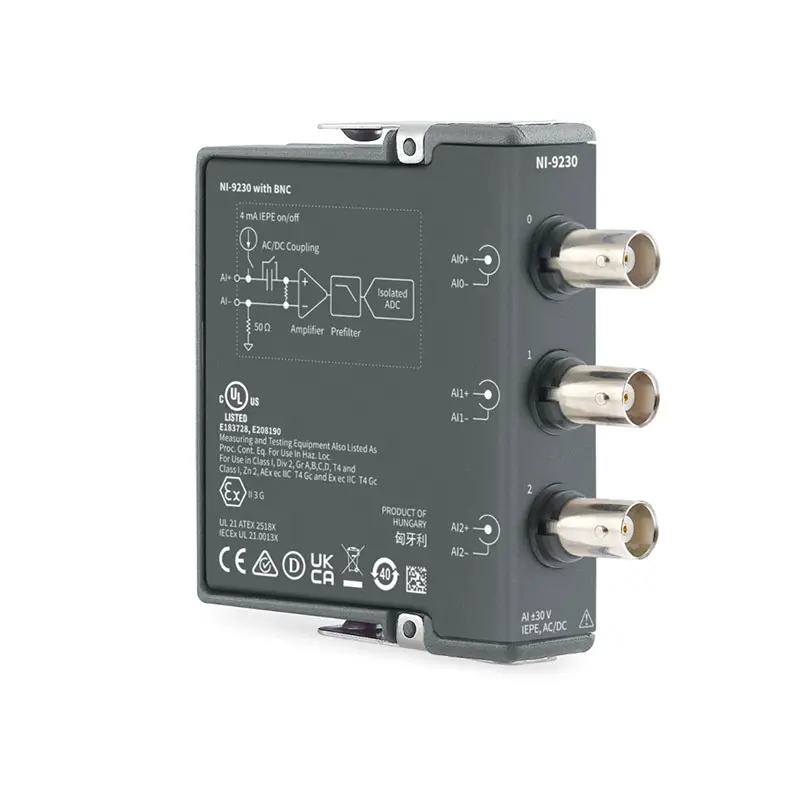
Земля NI-9230 is a three-channel C Series sound and vibration input module designed for IEPE sensors, industrial vibration monitoring and dynamic voltage measurements. It combines 24-bit delta-sigma converters, simultaneous sampling and software-selectable IEPE excitation in a rugged C Series format.
Each channel supports a nominal ±30 V input range and data rates up to 12.8 kS/s per channel. AC- or DC-coupled operation allows the same module to measure dynamic vibration signals, sensor bias voltages and other low-frequency or static voltage components.
Key Features of the NI-9230
- Three analog input channels
- 24-bit delta-sigma ADCs
- Simultaneous sampling on all channels
- Up to 12.8 kS/s per channel
- Nominal ±30 V input range
- Software-selectable AC or DC coupling
- 4.25 mA typical IEPE excitation
- 22 V minimum IEPE compliance voltage
- IEPE open-loop and short-circuit detection
- IEEE 1451.4 Class I TEDS support
- 120 dB stopband rejection
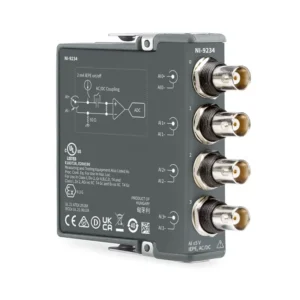
- Available with BNC, screw-terminal or snap-in connections
- Compatible with CompactDAQ and CompactRIO systems
- -40°C to 70°C operating range
NI-9230 Technical Specifications
| Product Model | NI-9230 |
|---|---|
| Product Type | C Series sound and vibration input module |
| Analog Input Channels | 3 |
| ADC Resolution | 24 bits |
| ADC Type | Delta-sigma with analog prefiltering |
| Sampling Mode | Синхронный |
| Internal Data Rate Range | 0.985 kS/s to 12.8 kS/s |
| External-Timebase Data Rate | 0.977 kS/s to 12.84 kS/s |
| Input Range | ±30.87 V minimum; ±31.5 V typical |
| Input Coupling | AC or DC, software selectable |
| AC-Coupling Cutoff | 0.1 Hz at -3 dB |
| IEPE Excitation | 4.25 mA typical, software selectable |
| IEPE Compliance Voltage | 22 V minimum |
| TEDS Support | IEEE 1451.4 Class I |
| Alias-Free Bandwidth | 0.4 × sample rate |
| Stopband Rejection | 120 dB |
| Overvoltage Protection | ±45 V between any two terminals |
| Operating Temperature | -40°C to 70°C |
IEPE Sensor Excitation
The NI-9230 can provide constant-current excitation directly through each AI+ connection. This allows compatible IEPE accelerometers and other powered sensors to operate without a separate external signal conditioner.
IEPE excitation can be enabled or disabled through software. When using a sensor, verify that its required current, bias voltage and signal amplitude remain within the module’s compliance-voltage range.
IEPE Fault Detection
The module can identify common IEPE wiring and sensor faults. An input voltage below the specified threshold can indicate a short circuit, while a voltage above the open-loop threshold may indicate a disconnected sensor or broken cable.
Fault status can be monitored in software to improve unattended monitoring and simplify troubleshooting in large sensor installations.
Simultaneous 24-Bit Acquisition
Each channel uses a dedicated 24-bit delta-sigma conversion path, so signals are acquired simultaneously rather than multiplexed through one converter. This preserves the timing relationship between channels for phase, order and vibration analysis.
Digital filtering provides an alias-free bandwidth equal to approximately 40 percent of the configured sample rate. Select a data rate that provides adequate bandwidth for the highest vibration frequency of interest.
AC and DC Coupling
AC coupling removes the static component of an input signal and is useful when a small vibration waveform is superimposed on a large DC sensor bias. DC coupling retains both static and dynamic components and is useful for sensor diagnostics and general voltage acquisition.
NI-9230 Part Number and Accessories
| Item | Описание |
|---|---|
| NI-9230 with BNC | Three-channel module with direct coaxial sensor connections |
| NI-9230 with Screw Terminal | Field-wiring version for bare-wire and fixture connections |
| NI-9230 with Snap-In Terminal | Removable terminal version for serviceable installations |
| IEPE Accelerometer | Constant-current-powered vibration sensor |
| Low-Noise Sensor Cable | Connects IEPE sensors while reducing triboelectric and electrical noise |
| Компактный шасси DAQ | Provides USB or Ethernet data acquisition and module synchronization |
| CompactRIO Chassis | Provides embedded real-time and FPGA-based operation |
The NI-9230 is available with several front-connector options. Confirm the complete ordering number and connector type because BNC and terminal versions require different sensor cables and installation hardware.
NI-9230 Applications
- Machine vibration monitoring
- IEPE accelerometer acquisition
- Мониторинг состояния
- Rotating machinery analysis
- Low-frequency vibration testing
- Motor and bearing diagnostics
- Structural vibration measurement
- Production noise and vibration testing
- Sensor bias monitoring
- Research and laboratory measurements
Мониторинг состояния оборудования
The NI-9230 can acquire signals from accelerometers mounted on motors, pumps, fans and gearboxes. Software can calculate RMS vibration, spectral amplitude, crest factor and other indicators used to identify changing machine condition.
Structural and Component Testing
Simultaneous channels preserve relative phase between several sensors, making the module useful for basic structural response, impact and vibration measurements within its frequency range.
NI-9230 Installation Workflow
Step 1: Select a Compatible Chassis
Install the NI-9230 in a supported CompactDAQ or CompactRIO chassis. Verify software support and chassis timing capabilities.
Step 2: Install the Driver
Install NI-DAQmx for CompactDAQ applications or the required CompactRIO software for real-time and FPGA operation.
Step 3: Connect the Sensors
Connect each sensor to the correct AI+ and AI- terminals or BNC connector. Keep low-level sensor cables separated from motor and power wiring.
Step 4: Configure IEPE and Coupling
Enable IEPE excitation only for compatible sensors. Select AC coupling for dynamic-only measurements or DC coupling when the static component is required.
Step 5: Configure the Sample Rate
Select a data rate that places the required signal spectrum inside the module’s alias-free bandwidth.
Step 6: Verify Sensor Status
Check the bias level and IEPE fault indication before recording production or long-duration data.
NI-9230 Troubleshooting
The accelerometer produces no signal
Verify that IEPE excitation is enabled and that the sensor supports the available excitation current. Inspect the cable for open or short circuits.
The module reports an open-loop condition
Check for a disconnected sensor, damaged cable or loose terminal. Measure the sensor bias voltage and compare it with the manufacturer’s requirements.
The signal clips
Confirm that the combined DC bias and AC waveform remain within the input and IEPE compliance limits. Reduce vibration amplitude or use a sensor with lower sensitivity.
The waveform contains unexpected low-frequency drift
Use AC coupling when the DC component is not required. Check cable movement, thermal effects, mounting and grounding.
Phase measurements are inconsistent
Confirm that all channels are in the same task and use identical acquisition settings. Inspect sensor orientation, mounting and cable routing.
NI-9230 Comparison
| Модель | Primary Configuration | Best Suited For |
|---|---|---|
| NI-9230 | 3 channels, 24-bit, 12.8 kS/s/ch, ±30 V | Low-frequency IEPE and higher-voltage dynamic signals |
| NI-9234 | 4 channels, 24-bit, higher sample rate | General sound and vibration acquisition |
| NI-9250 | Automotive-focused dynamic input | Vehicle and ECU noise and vibration testing |
| NI-9232 | 3-channel high-speed dynamic input | Higher-bandwidth vibration analysis |
Selecting the NI-9230
Choose the NI-9230 when the application requires three simultaneous 24-bit channels, integrated IEPE excitation and a relatively high ±30 V input range. Choose a higher-speed dynamic signal module when the vibration spectrum extends beyond the NI-9230 alias-free bandwidth.
NI-9230 Frequently Asked Questions
How many input channels does the NI-9230 have?
It provides three simultaneously sampled analog input channels.
What is the maximum sample rate?
The maximum internal-timebase data rate is 12.8 kS/s per channel.
Does it power IEPE accelerometers?
Yes. It supplies approximately 4.25 mA of software-selectable constant-current excitation.
Does it support TEDS?
Yes. The module supports IEEE 1451.4 Class I TEDS sensors.
Can it measure DC voltage?
Yes. Select DC coupling when the static voltage and dynamic signal components must both be retained.
Which connectors are available?
NI offers BNC, screw-terminal and snap-in-terminal versions.
Request a Quote for the NI-9230
Contact us for availability, lead time and project pricing for the NI-9230 sound and vibration input module. We can also help select compatible IEPE sensors, cables, CompactDAQ chassis and related dynamic signal modules.