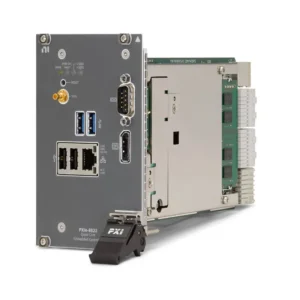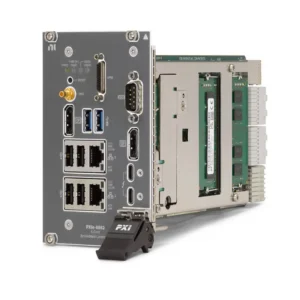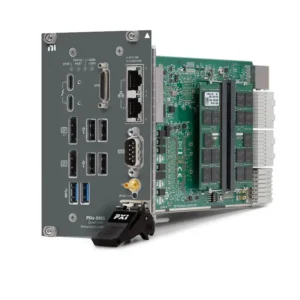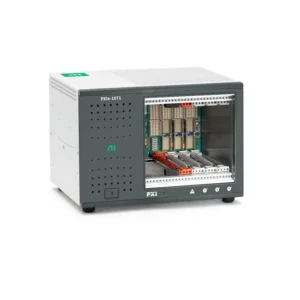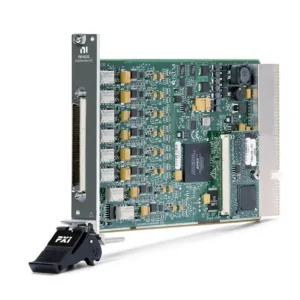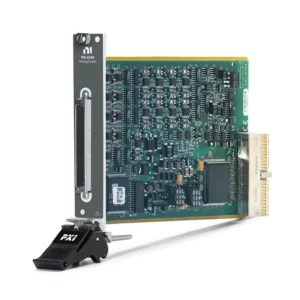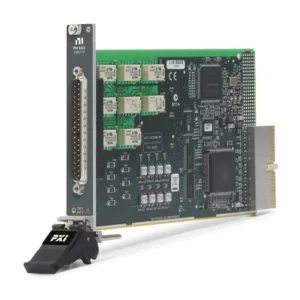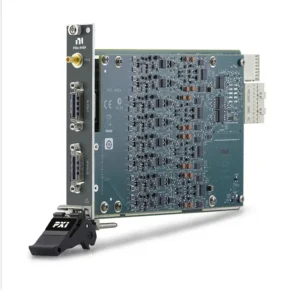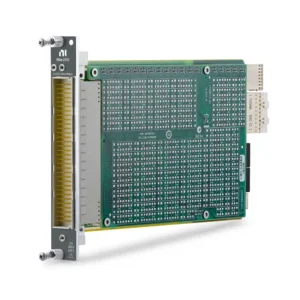






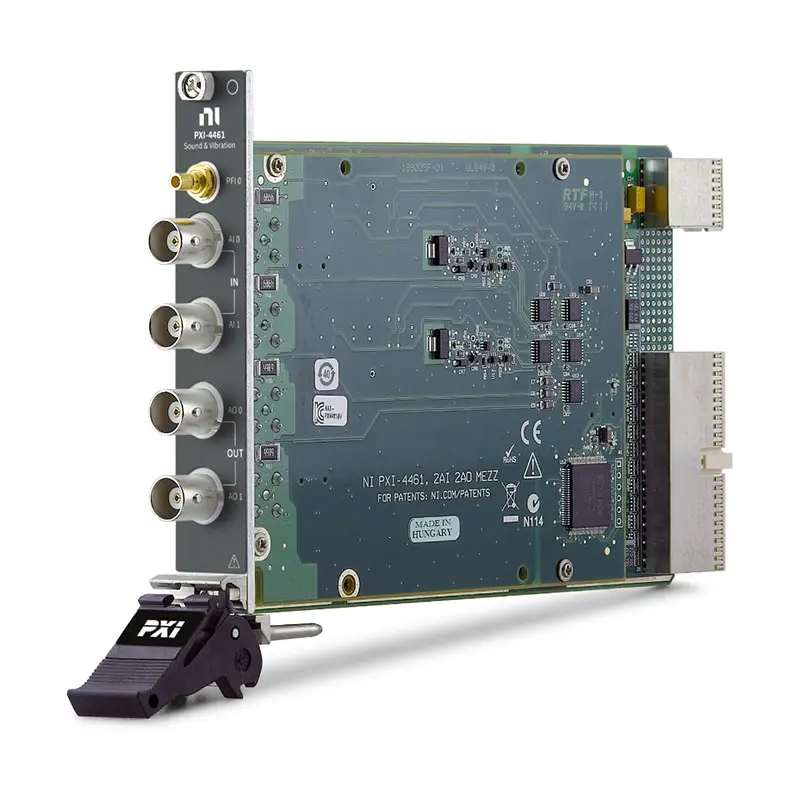
PXI-4461 24-Bit 204.8 kS/s Sound and Vibration Module
Земля NI PXI-4461 is a high-performance dynamic signal acquisition and generation module designed for sound, vibration and high-fidelity audio testing. It provides two simultaneously sampled analog input channels and two simultaneously updated analog output channels with 24-bit resolution and sampling rates up to 204.8 kS/s per channel.
The PXI-4461 combines precision delta-sigma converters, software-selectable input ranges, AC or DC input coupling, IEPE sensor excitation and digital antialiasing filters. It is suitable for measurements using microphones, accelerometers, acoustic sensors and other transducers with wide dynamic ranges.
Key Features of the PXI-4461
- Two simultaneously sampled analog input channels
- Two simultaneously updated analog output channels
- 24-bit delta-sigma ADC and DAC resolution
- Up to 204.8 kS/s sampling and update rate per channel
- Input ranges from approximately ±316 mV to ±42.4 V
- Six software-selectable input gain settings
- ±10 V analog output capability
- Up to 118 dB input dynamic range
- Software-selectable AC or DC input coupling
- Software-configurable 4 mA or 10 mA IEPE excitation
- Differential and pseudodifferential input configurations
- Integrated digital antialiasing filters
- Analog output anti-imaging filtering
- Approximately 92 kHz alias-free input bandwidth
- Analog and digital triggering
- Multimodule synchronization through the PXI backplane
- BNC analog input and output connectors
- SMB external digital trigger connector
- NI-DAQmx software support
- PXI Express hybrid-slot-compatible version available
PXI-4461 Technical Specifications
| Product Model | PXI-4461 |
|---|---|
| Primary Part Number | 779687-01 |
| Legacy PXI Part Number | 778442-01 |
| Product Type | PXI dynamic signal acquisition and generation module |
| Primary Application | Sound, vibration, audio and dynamic signal testing |
| Analog Input Channels | 2, simultaneously sampled |
| Analog Output Channels | 2, simultaneously updated |
| ADC Resolution | 24 bits |
| DAC Resolution | 24 bits |
| ADC Architecture | Delta-sigma |
| Maximum Input Sample Rate | 204.8 kS/s per channel |
| Maximum Output Update Rate | 204.8 kS/s per channel |
| Minimum Sample Rate | 1 kS/s |
| Input Voltage Ranges | Approximately ±316 mV to ±42.4 V peak |
| Number of Input Gain Settings | 6 per input channel |
| Analog Output Range | ±10 V |
| Input Dynamic Range | Up to approximately 118 dB |
| Alias-Free Input Bandwidth | Up to approximately 92 kHz |
| Input Coupling | Software-selectable AC or DC per channel |
| Output Coupling | DC coupled |
| IEPE Excitation | Software-selectable 4 mA or 10 mA per input channel |
| Input Terminal Configuration | Differential or pseudodifferential |
| Analog I/O Connectors | Female BNC |
| External Digital Trigger Connector | Male SMB |
| Input Filtering | Digital antialiasing filter |
| Output Filtering | Anti-imaging filter |
| FIFO Buffer | 2,047 samples |
| Data Transfer | Direct memory access |
| Internal Timebase Accuracy | ±20 ppm over the operating temperature range |
| Software Driver | НИ-DAQmx |
| Шинный интерфейс | PXI; hybrid-compatible version supports PXI Express hybrid slots |
| Operating Temperature | 0°C to 55°C |
| Storage Temperature | −20°C to 70°C |
| Dimensions | Approximately 16 × 10 cm, excluding connectors |
| Weight | Approximately 241 g |
PXI-4461 Part Numbers and Versions
| Item | Part Number | Описание |
|---|---|---|
| PXI-4461 Hybrid-Compatible Version | 779687-01 | 24-bit, two-input and two-output sound and vibration module for standard PXI or compatible PXI Express hybrid slots |
| PXI-4461 Legacy PXI Version | 778442-01 | Earlier standard PXI version of the two-input and two-output DSA module |
| IEPE Accelerometer | Sensor dependent | Constant-current-powered sensor for vibration and machine-condition measurements |
| IEPE Measurement Microphone | Sensor dependent | Microphone or preamplifier system for acoustic measurements |
| BNC Signal Cable | Configuration dependent | Shielded cable for analog input or output connections |
| SMB Trigger Cable | Configuration dependent | Cable for external digital triggering and synchronization |
Two PXI-4461 ordering versions have been offered. Part number 779687-01 is the PXI Express-ready, hybrid-slot-compatible version, while 778442-01 is associated with the earlier standard PXI implementation. Confirm the chassis slot type and exact module part number before ordering.
Two Simultaneous Analog Inputs
The PXI-4461 provides two analog input channels with independent 24-bit delta-sigma converters. Both channels are sampled simultaneously, preserving the phase relationship between measured signals.
Simultaneous sampling is essential for transfer-function measurements, phase analysis, stereo audio testing, structural response measurements and applications comparing a stimulus signal with a system response.
Two High-Fidelity Analog Outputs
Two simultaneously updated 24-bit analog outputs allow the PXI-4461 to generate precision stimulus signals while acquiring the system response. The outputs can generate sine waves, swept-frequency signals, broadband noise and arbitrary test waveforms.
A typical application uses one output to stimulate a loudspeaker, amplifier, mechanical actuator or electronic device while the input channels measure the reference and response signals.
204.8 kS/s Sampling Rate
Each input and output channel supports rates up to 204.8 kS/s. The sampling rate provides an alias-free input bandwidth of approximately 92 kHz, covering standard audio frequencies and many vibration-analysis applications.
The programmable sample rate also supports common audio rates such as 44.1 kS/s and 48 kS/s. Engineers can therefore use the module for consumer audio, professional audio and general dynamic signal measurements.
24-Bit Delta-Sigma Conversion
The PXI-4461 uses 24-bit delta-sigma conversion to provide low noise, low distortion and wide dynamic range. This architecture is optimized for signals such as sound pressure, acceleration, vibration, strain-related response and high-fidelity audio.
Delta-sigma converters use oversampling and digital filtering. Measurements therefore include a filter delay that should be considered when synchronizing the module with other instruments or interpreting the beginning of an acquired record.
Six Input Voltage Ranges
Each analog input channel provides six software-selectable gain settings, covering signal ranges from approximately ±316 mV to ±42.4 V peak. The range can be selected independently for each channel.
Selecting the smallest range that safely contains the expected signal improves use of the ADC’s dynamic range. A range that is too small can cause clipping, while a range that is unnecessarily large can reduce measurement sensitivity.
Up to 118 dB Dynamic Range
The input system offers a dynamic range of up to approximately 118 dB under specified conditions. Wide dynamic range helps the module measure small vibration or acoustic signals while accommodating significantly larger signal components.
System-level dynamic range also depends on sensor noise, cable interference, grounding, selected voltage range, sampling rate and the mechanical or acoustic test environment.
Software-Selectable AC and DC Coupling
Each input can be configured independently for AC or DC coupling. DC coupling preserves both the static signal level and its dynamic variations. AC coupling blocks the DC component and is useful when a small time-varying signal is superimposed on a larger DC offset.
AC coupling uses a high-pass response with a cutoff frequency of approximately 3.4 Hz. Allow sufficient settling after enabling AC coupling or connecting a signal containing a large DC component.
IEPE Sensor Conditioning
The PXI-4461 includes software-configurable IEPE constant-current excitation on both analog input channels. Each channel can supply 4 mA or 10 mA for compatible microphones, accelerometers and other integrated-electronics piezoelectric sensors.
Integrated IEPE excitation reduces the need for separate external signal conditioners. The sensor must support the selected excitation current and operate within the module’s compliance-voltage and input-range limits.
Differential and Pseudodifferential Inputs
Each input channel can be configured as differential or pseudodifferential. Differential mode is useful for floating signal sources and applications requiring improved rejection of common-mode interference.
Pseudodifferential mode provides a controlled reference between the BNC shell and chassis through resistance. The appropriate mode depends on how the sensor, signal source and test fixture are grounded.
Antialiasing Protection
Integrated digital antialiasing filters track the programmed sampling rate and attenuate frequency components that could fold into the measurement bandwidth. This simplifies sound and vibration system design because separate external antialiasing filters are not normally required.
When operating above 102.4 kS/s, the available alias-rejection behavior differs from operation at lower sample rates. Review the official filter specifications when measuring strong signals near or above the usable bandwidth.
Analog Output Anti-Imaging Filtering
The analog outputs include anti-imaging filtering to reduce unwanted spectral replicas produced during digital-to-analog conversion. This helps generate clean audio and vibration stimulus signals.
The output channels are rated to drive loads of 600 Ω or greater. Larger load resistance, such as 10 kΩ, generally provides better amplitude accuracy and lower distortion.
Analog and Digital Triggering
The PXI-4461 supports analog and digital triggering. Analog triggering starts an acquisition according to the measured signal level, while digital triggering coordinates acquisition or generation with an external event or another PXI instrument.
The front-panel SMB connector and PXI backplane trigger resources can be used for deterministic test sequencing and repeatable transient capture.
PXI Multimodule Synchronization
Onboard phase-locked-loop circuitry synchronizes the PXI-4461 sample clock to PXI timing resources. Multiple compatible DSA modules can share timing and trigger signals for expanded channel-count systems.
This capability is useful for structural testing, microphone arrays, acoustic mapping and other applications requiring phase-coherent measurements across more channels than one module provides.
Sound and Acoustic Measurements
The PXI-4461 can acquire signals from measurement microphones and simultaneously generate acoustic stimulus waveforms. Typical measurements include sound-pressure level, frequency response, harmonic distortion, loudspeaker response and acoustic transfer functions.
Accurate acoustic testing also requires a calibrated microphone, suitable preamplifier, acoustic calibrator and controlled measurement environment.
Vibration and NVH Testing
IEPE conditioning allows compatible accelerometers to connect directly to the PXI-4461. Engineers can measure acceleration, frequency spectra, resonance, phase and vibration response in automotive noise, vibration and harshness testing.
The analog outputs can provide stimulus signals for modal shakers or other excitation systems through an appropriate power amplifier. The output must not be connected directly to loads requiring more voltage or current than the module can supply.
Audio Device Testing
The high-resolution inputs and outputs make the PXI-4461 suitable for testing amplifiers, filters, audio converters and other electronic audio devices. Common measurements include frequency response, signal-to-noise ratio, total harmonic distortion and channel crosstalk.
For production audio testing, automated software can generate a stimulus, acquire the response and calculate pass-or-fail results without separate signal-generator and analyzer instruments.
Мониторинг состояния оборудования
The PXI-4461 can acquire vibration signals from rotating machinery, motors, pumps, fans, gearboxes and bearings. Frequency-domain processing can identify imbalance, misalignment, looseness, bearing defects and other mechanical problems.
Trend measurements should use consistent sensor placement, mounting method, measurement range, sampling rate and operating conditions to provide meaningful comparisons over time.
NI-DAQmx Software Support
The PXI-4461 is controlled through the NI-DAQmx driver. NI-DAQmx provides functions for configuring voltage ranges, coupling, IEPE excitation, terminal mode, sample rate, triggering, synchronization and continuous data streaming.
The driver supports LabVIEW, LabWindows/CVI and compatible text-based programming environments. Sound and vibration analysis software can provide additional frequency-domain, octave, order-tracking and audio-test functions.
Typical PXI-4461 Applications
- Audio frequency-response testing
- Sound-pressure measurements
- Microphone testing and calibration systems
- Loudspeaker and headphone testing
- Amplifier and audio-electronics validation
- Automotive NVH testing
- Vibration and acceleration measurements
- Structural modal analysis
- Transfer-function measurements
- Мониторинг состояния оборудования
- Диагностика вращающегося оборудования
- Acoustic research
- Production acoustic testing
- Dynamic signal generation
- Phase-coherent multichannel measurements
PXI-4461 Troubleshooting
The module is not detected in NI MAX
Confirm that the PXI-4461 is fully inserted into a compatible slot. Check chassis power, controller communication and NI-DAQmx installation. For part number 779687-01, verify that the PXI Express slot is a hybrid-compatible peripheral slot.
The IEPE sensor produces no signal
Verify that IEPE excitation is enabled and that the selected 4 mA or 10 mA current is compatible with the sensor. Check sensor polarity, cable continuity, compliance voltage and the selected input range.
The acquired waveform is clipped
Select a larger input range and confirm that the signal remains within the maximum input specification. Check whether sensor sensitivity or external amplification is producing an unexpectedly large voltage.
The signal contains excessive low-frequency drift
Use AC coupling when DC response is unnecessary, or inspect the sensor mounting, cable and grounding when DC coupling is required. Allow the high-pass filter to settle after changing connections.
The measurement contains 50 Hz or 60 Hz interference
Check grounding and shielding, shorten signal cables and select differential input mode where appropriate. Avoid creating ground loops between the sensor, test article, chassis and external instruments.
The analog output amplitude is lower than expected
Verify the connected load impedance. The output is designed for loads of 600 Ω or greater, with better performance generally obtained at higher impedance. Check cable termination and output-range configuration.
Channels are not phase aligned
Confirm that both channels use the same sample clock and begin from the same trigger. For multiple modules, configure the PXI reference clock, clock master and trigger routing correctly.
The first samples after a configuration change are invalid
Delta-sigma converters and digital filters require settling time. Discard the appropriate number of initial samples after changing gain, coupling, sample rate or other signal-path settings.
PXI-4461 Comparison with Similar Sound and Vibration Modules
| Модель | Channel Configuration | Best Suited For |
|---|---|---|
| PXI-4461 | 2 analog inputs and 2 analog outputs, 24-bit, 204.8 kS/s | Combined dynamic signal acquisition and stimulus generation |
| PXI-4462 | 4 analog inputs, 24-bit, 204.8 kS/s | Higher input-channel density without analog generation |
| PXI-4472B | 8 analog inputs, 24-bit, 102.4 kS/s | Multichannel acoustic and vibration acquisition |
| PXIe-4492 | 16 analog inputs, 24-bit, 204.8 kS/s | High-channel-count microphone and vibration systems |
| PXIe-4464 | 6 analog inputs, 24-bit dynamic signal acquisition | Modern PXI Express sound and vibration measurements |
PXI-4461 vs PXI-4462
The PXI-4461 provides two input and two output channels, while the PXI-4462 provides four input channels without analog outputs. Both use 24-bit delta-sigma conversion and support sampling rates up to 204.8 kS/s.
Select the PXI-4461 when the test requires both stimulus generation and response acquisition. Choose the PXI-4462 when additional input channels are more important than analog output capability.
PXI-4461 vs PXI-4472B
The PXI-4461 offers two input and two output channels at up to 204.8 kS/s. The PXI-4472B provides eight input channels at a lower maximum sampling rate of 102.4 kS/s and does not provide the same analog output generation.
Choose the PXI-4461 for two-channel acquisition and generation or for wider measurement bandwidth. Select the PXI-4472B for higher input-channel density in acoustic and vibration systems.
PXI-4461 vs PXIe-4492
The PXIe-4492 provides substantially more analog input channels for large microphone arrays and structural test systems. The PXI-4461 has fewer inputs but includes two high-fidelity analog outputs for stimulus generation.
Select the PXI-4461 for compact stimulus-and-response systems. Choose the PXIe-4492 for modern PXI Express systems requiring high-density acoustic acquisition.
Recommended Related Products
- PXI-4462 4-Channel Dynamic Signal Acquisition Module
- PXI-4472B 8-Channel Sound and Vibration Module
- PXIe-4464 Dynamic Signal Acquisition Module
- PXIe-4492 16-Channel Sound and Vibration Module
- PXIe-1082 PXI Express Chassis
- PXIe-1073 MXI-Express Chassis
- View More NI PXI and PXI Express Modules
Selecting the Right Sound and Vibration Module
Choose the PXI-4461 when the application requires two high-resolution dynamic inputs, two precision outputs, IEPE conditioning and sampling rates up to 204.8 kS/s. It is particularly well suited to stimulus-and-response testing.
Select the PXI-4462 or PXI-4472B when additional acquisition channels are needed without analog outputs. Consider a newer PXI Express DSA module when the system requires higher channel density, updated driver support or a PXI Express-only architecture.
Before ordering a PXI-4461, confirm the exact part number, chassis-slot compatibility, calibration status, NI-DAQmx version and whether the application requires compatible IEPE sensors, BNC cables or external signal-conditioning equipment.
Why Choose the PXI-4461?
- Combines dynamic signal acquisition and generation
- Provides two simultaneous 24-bit inputs and outputs
- Supports sampling rates up to 204.8 kS/s
- Offers wide input ranges and high dynamic range
- Connects directly to compatible IEPE sensors
- Includes AC and DC coupling
- Provides antialiasing and anti-imaging protection
- Supports phase-coherent multimodule systems
- Integrates with NI-DAQmx and LabVIEW
- Supports audio, vibration, NVH and machine-monitoring applications
Frequently Asked Questions
What is the PXI-4461?
The PXI-4461 is a 24-bit PXI sound and vibration module with two simultaneous analog inputs, two simultaneous analog outputs and sampling rates up to 204.8 kS/s.
What is the primary PXI-4461 part number?
The hybrid-slot-compatible PXI-4461 part number is 779687-01. The earlier standard PXI version is associated with part number 778442-01.
How many input and output channels does it provide?
The PXI-4461 provides two analog input channels and two analog output channels.
What is the maximum sampling rate?
The maximum input sampling and analog output update rate is 204.8 kS/s per channel.
What is the input resolution?
The input channels use 24-bit delta-sigma analog-to-digital converters. The analog outputs also provide 24-bit resolution.
Does the PXI-4461 support IEPE sensors?
Yes. Each input channel provides software-configurable 4 mA or 10 mA IEPE excitation for compatible microphones and accelerometers.
What are the available input ranges?
The module provides six gain settings covering input ranges from approximately ±316 mV to ±42.4 V peak.
Does it support AC and DC coupling?
Yes. AC or DC input coupling can be selected independently for each analog input channel.
Can the PXI-4461 generate audio signals?
Yes. Its two 24-bit analog outputs can generate audio-frequency stimulus signals and arbitrary waveforms within the module’s output limits.
Which driver controls the PXI-4461?
The PXI-4461 is controlled through the NI-DAQmx driver and can be programmed with LabVIEW, LabWindows/CVI and supported text-based environments.
Can multiple PXI-4461 modules be synchronized?
Yes. Multiple modules can share clock and trigger resources through the PXI backplane for synchronized, phase-coherent measurements.
Is the PXI-4461 compatible with a PXI Express chassis?
Part number 779687-01 can operate in compatible PXI Express hybrid peripheral slots. It cannot be installed in a PXI Express-only slot that lacks the hybrid connector interface.
Request a Quote for the PXI-4461
Contact us for current availability, product condition, calibration status, lead time and project pricing for the PXI-4461 24-Bit 204.8 kS/s Sound and Vibration Module. We can also help identify compatible PXI chassis, controllers, IEPE microphones, accelerometers, BNC cables and related dynamic signal acquisition modules.